
History of jali: from carved stone to GRC
Long before air conditioning, Indian builders cooled, lit and screened their buildings with perforated stone. Here’s how that idea became today’s GRC jali.
The jali (jaali, “net”) is a perforated screen that has been carved in stone and wood in the Indian subcontinent for centuries, reaching a peak in the Indo-Islamic and Mughal periods. It controls glare, lets breezes through and gives privacy. GRC jali is the modern version: the same patterns cast in glass fibre reinforced concrete, a material made practical by alkali-resistant glass fibre developed in Britain around 1970.

What “jali” means
The word jali (also jaali) means net or lattice in Hindi and Urdu. In architecture it describes a screen pierced with a repeating pattern of openings: geometric stars and polygons, floral scrolls, or calligraphy. The closely related jharokha is an overhanging, enclosed window, often itself filled with jali.
Why builders used jali
The jali was a climate device first and an ornament second.
- Glare and heat: small openings break harsh sunlight into soft, dappled light and cut solar gain into rooms.
- Ventilation: air keeps moving through the screen.
- Privacy: from the bright outside you see the pattern, not the interior, while people inside can see out. This mattered in palaces, homes and zenana quarters.
- Meaning and beauty: geometry, flowers and script carried religious and cultural symbolism, and the moving shadows became part of the architecture.
Landmark jalis in India
A few well-documented examples show how far the craft developed:
| Building | Place and date | Why it matters |
|---|---|---|
| Sidi Saiyyed Mosque | Ahmedabad, completed 1572–73 | Its carved stone “tree of life” jali is among the most famous in the world and has become a symbol of Ahmedabad. |
| Tomb of Salim Chishti | Fatehpur Sikri, late 16th century | Delicate white marble screens enclose the tomb, showing the Mughal mastery of geometric jali. |
| Taj Mahal | Agra, 17th century | An octagonal pierced-marble screen inlaid with stones surrounds the cenotaphs. |
| Hawa Mahal | Jaipur, built 1799 | A five-storey façade of 953 small windows (jharokhas) with latticework let royal women watch the street unseen while breezes cooled the rooms. |
Stone jali appears across the subcontinent, from Gujarat’s Sultanate mosques to Rajasthan’s havelis, in local sandstone, marble and wood.
Why stone jali became rare
In the 20th century jali largely disappeared from everyday buildings. Hand carving is slow and expensive, stone is heavy, and frame construction with glass windows and, later, air conditioning made screens seem unnecessary. Cheaper substitutes appeared: cement “jali blocks”, terracotta screens and, later, metal and laser-cut panels. Architects such as Laurie Baker revived brick and terracotta jali walls as a low-cost way to cool buildings, keeping the idea alive.
How GRC made jali practical again
The key invention had nothing to do with India. Ordinary glass fibre had been tried as reinforcement for cement but was slowly destroyed by the cement’s alkalinity. In the late 1960s the UK’s Building Research Establishment developed an alkali-resistant (AR) glass containing zirconia, and Pilkington began producing it commercially as Cem-FIL in the early 1970s. With AR fibre, cement could be reinforced without steel and cast thin. That was glass fibre reinforced concrete, or GRC.
For jali, GRC solved the old problems at once:
- Weight: a 30–35 mm GRC jali weighs a fraction of a carved stone screen of the same size, so it can go on upper floors and slab edges.
- Cost and speed: one master pattern and mould can produce hundreds of identical panels.
- Durability: no steel to rust, no timber to rot, and the material is non-combustible.
- Freedom of design: traditional Mughal geometry and modern parametric patterns are equally easy to cast.
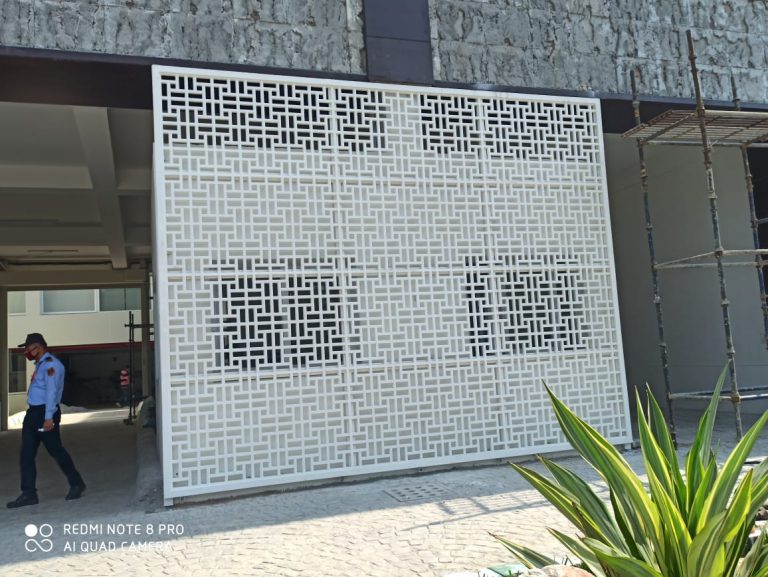
In recent decades GRC jali has spread across India on hotels, institutions, temples and, increasingly, homes. We have cast it since 2012 for projects ranging from private residences to Taj Palace, New Delhi and power projects of NTPC and NPCIL.
What modern jali can learn from the originals
- Put it where the sun is. The old builders used jali on hot façades and courtyards, not everywhere. West and south elevations benefit most.
- Size the openings for the job. Fine patterns for privacy, larger openings for airflow.
- Depth matters. A deeper screen casts more shade when the sun is at an angle, which is part of why carved stone jalis worked so well. A 30–35 mm GRC jali keeps much of that effect.
- Pattern should suit the viewing distance. Palace jalis are fine near eye level and bolder high up. That still holds on a modern elevation.
Thinking about a jali for your building? Our complete GRC jali guide covers design, thickness, cost and fixing.
Frequently asked questions
What is the origin of jali?
Pierced stone and wooden screens have a long history in Indian, Persian and Islamic architecture. In India the jali reached its height in the Indo-Islamic and Mughal periods (roughly the 15th to 17th centuries), in buildings such as the Sidi Saiyyed Mosque in Ahmedabad and the tomb of Salim Chishti at Fatehpur Sikri.
Which is the most famous jali in India?
The “tree of life” jali of the Sidi Saiyyed Mosque in Ahmedabad, completed in 1572–73, is probably the best known. The Hawa Mahal in Jaipur is the most famous jali-like façade.
When did GRC jali start?
GRC became possible with alkali-resistant glass fibre in the early 1970s. It has since become widespread in Indian construction as a lighter, cheaper alternative to carved stone.
Is jali still useful in modern buildings?
Yes. A jali on a sun-facing façade reduces glare and heat gain while keeping ventilation and daylight. That’s the same reason it was used centuries ago.
Sources and further reading
- Sidi Saiyyed Mosque (Wikipedia) and the Ahmedabad Municipal Corporation heritage listing
- Hawa Mahal (Wikipedia)
- PCI Journal (1977), on the development of AR glass fibre at the Building Research Establishment

About the author
Written by the people who draw, mould, cast and install GRC at Asian GRC, a Gurugram manufacturer working in glass fibre reinforced concrete since 2012. Our work includes GRC jali for Taj Palace, New Delhi (G20 Summit 2023) and for power projects of NTPC and NPCIL. Figures in our articles come from our own production and site work, or from the standards and sources we cite.


Want a jali with heritage character?
We cast traditional and modern patterns in GRC, or work from your own drawing.