
How to choose a GRC jali manufacturer in India: a 12-point checklist
Two quotes can say “GRC jali, ₹ per sq ft” and describe very different products. These are the questions that separate them, and you should ask them of any supplier, including us.
Choose a GRC jali manufacturer who will put these in writing: AR glass fibre, the thickness, the manufacturing method, the curing period and the fixing method. They should also show you completed projects you can verify and give you a physical sample before production. A supplier who can’t answer these clearly is pricing a different product.
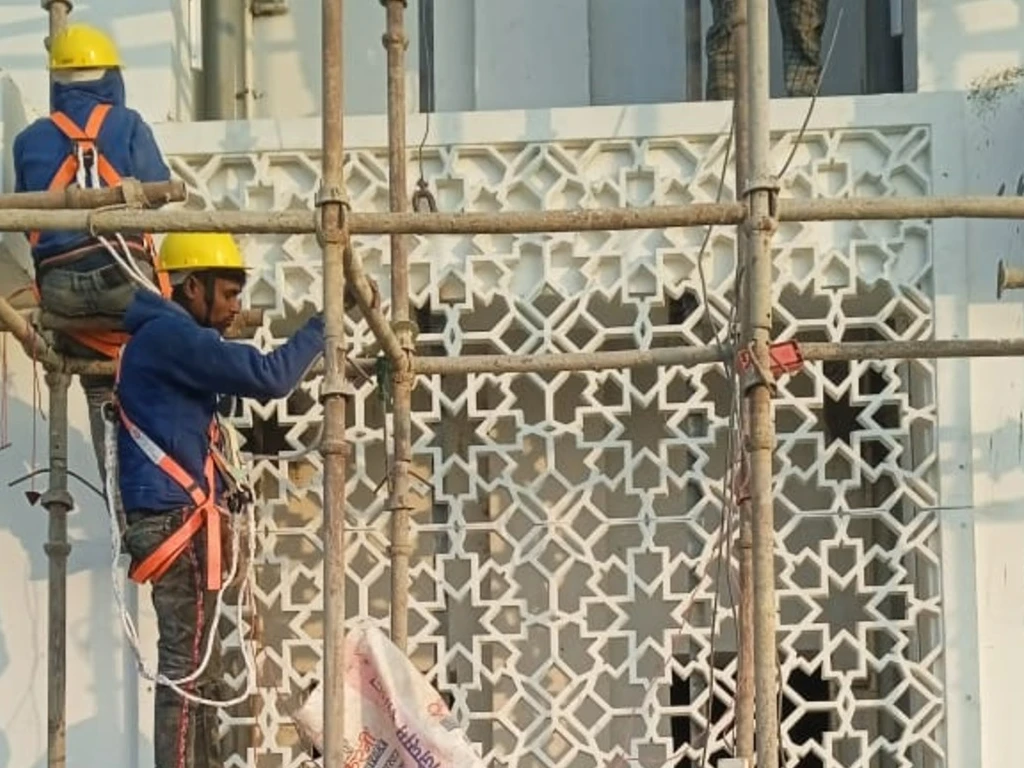
Questions about the material
1. Is the glass fibre alkali-resistant (AR)?
This is the most important question. Cement is strongly alkaline and slowly destroys ordinary glass fibre, and jali made with it can lose strength and crack within a few years. AR fibre contains zirconia to resist this. Ask for the fibre brand and its data sheet.
2. What thickness are you quoting?
Rates per sq ft mean nothing without thickness. A 20 mm jali is cheaper than a 35 mm jali for a reason. For exterior work we use 30–35 mm as standard, and 40 mm or a steel frame for large or high panels. If one quote is far cheaper than the others, check this first.
3. Sprayed or premixed?
Sprayed GRC has more fibre and higher bending strength, which suits façade jali and large panels. Premix is fine for small and solid pieces. A good supplier will tell you which they use for your job and why. Our technical guide to GFRC explains the difference.
4. How are panels cured?
Fresh GRC needs to stay moist while it gains strength, typically about 7 days under cover, or it needs a polymer-modified mix designed to cure without that. Panels rushed out of the factory are a common cause of surface crazing and warping.
Questions about quality control
5. Do you test your production?
Ask whether they cast test boards and check bending strength, dry density or fibre content. Even simple, regular in-house tests show a manufacturer controls its mix rather than guessing.
6. Can I see and keep a sample?
A physical sample in your chosen pattern, thickness and finish is the best way to agree what “good” looks like. Keep it, and compare deliveries against it.
7. Who makes the moulds?
Crisp, accurate jali comes from a good master pattern and mould. For custom designs, ask how the pattern is made (hand, CNC or 3D model), how the mould is made, and who owns the mould once you’ve paid for it.
Questions about installation
8. How will each panel be fixed?
The answer should name a mechanical fixing: stainless-steel anchors into RCC, a galvanised or stainless sub-frame, or cast-in sockets and brackets. “We fix it with mortar” is not enough for exterior or high-level jali.
9. Do you install, or only supply?
If the supplier installs, one company is responsible for the result. If not, make sure your contractor has GRC experience and agree who handles breakages, joints and touch-ups.
Questions about the company
10. Can I see projects similar to mine?
Ask for addresses or photos of completed work at a similar scale, with the client named where possible, and visit one if you can. A jali that has been through several monsoons tells you more than a showroom piece. You can see our own project list, which includes Taj Palace, New Delhi and power projects for NTPC and NPCIL.
11. Are you a registered business?
Check GST registration, a physical address and a landline or business number. It protects you on invoicing and makes the supplier accountable. Ours: GSTIN 06ADCPI2643A1ZA, 65 Siris Road, DLF Phase 3, Gurugram.
12. What exactly is in the quote?
A clear quote lists the design, thickness, finish, area, rate, fixing method, scope (supply or supply and fix), scaffolding, transport, taxes, lead time and payment milestones. Anything left out is likely to become an extra later.
Red flags
- A rate well below the market with no thickness stated.
- Vague answers about fibre (“it’s glass fibre, same thing”).
- No sample offered before production.
- Photos only from the internet, or the same photos on many websites.
- Full payment demanded upfront for custom work.
- No mechanical fixing for exterior panels.
Comparing quotes side by side
Put competing quotes into a simple table before deciding:
| Check | Supplier A | Supplier B |
|---|---|---|
| AR glass fibre (brand) | ||
| Thickness | ||
| Spray / premix | ||
| Finish | ||
| Fixing method | ||
| Installation included | ||
| Sample before production | ||
| Lead time (written) | ||
| Rate per sq ft, all-in |
Only then compare price. For reference, our standard GRC jali starts at about ₹350 per sq ft for supply, with a minimum order of 1,000 sq ft in Delhi NCR and 1,500 sq ft elsewhere.
Where we supply
We are based in Gurugram and supply and install across India, including Delhi, Gurgaon, Noida, Faridabad, Jaipur, Lucknow, Dehradun, Chandigarh and Hyderabad. See GRC jali manufacturer for our product range.
Frequently asked questions
Why do GRC jali prices vary so much between suppliers?
Mostly because of thickness, fibre type and content, finish and whether installation is included. Compare quotes on the same specification before comparing price.
Should I buy GRC jali from a local supplier or a large manufacturer?
Distance matters less than quality and accountability. A local supplier is easier to visit; a larger manufacturer may have more moulds and installation teams. Either way, ask the same twelve questions.
Do GRC jali manufacturers provide installation?
Many do, including us. If yours doesn’t, make sure the installer uses mechanical fixings and leaves movement joints between panels.
How can I check whether a manufacturer uses AR glass fibre?
Ask for the fibre brand and data sheet, and for the purchase invoice if in doubt. Reputable AR fibre is sold under named brands with published zirconia content.

About the author
Written by the people who draw, mould, cast and install GRC at Asian GRC, a Gurugram manufacturer working in glass fibre reinforced concrete since 2012. Our work includes GRC jali for Taj Palace, New Delhi (G20 Summit 2023) and for power projects of NTPC and NPCIL. Figures in our articles come from our own production and site work, or from the standards and sources we cite.


Put us to the test
Ask us all twelve questions. We'll answer them in writing with your quotation.