
GRC and FRP full form in civil engineering, with examples
Architectural drawings and quotations are full of acronyms. Here’s what the common ones mean, and what’s actually different between them.
- GRC full form: Glass fibre Reinforced Concrete (also Glass Reinforced Concrete or Glassfibre Reinforced Cement). It is a thin cement composite reinforced with alkali-resistant glass fibre.
- FRP full form: Fibre Reinforced Plastic, also Fibre Reinforced Polymer. It is a plastic resin (polyester, vinyl ester or epoxy) reinforced with glass, carbon or aramid fibre.
The key difference: GRC is bound with cement, so it is mineral and non-combustible. FRP is bound with plastic resin, so it is lighter but combustible unless specially formulated.

GRC: Glass fibre Reinforced Concrete
GRC is a mix of cement, fine sand, water, admixtures and alkali-resistant (AR) glass fibre. The fibre replaces steel bars, so there is nothing to rust and no need for thick concrete cover. Panels can be as thin as 10–40 mm. In construction it’s used for:
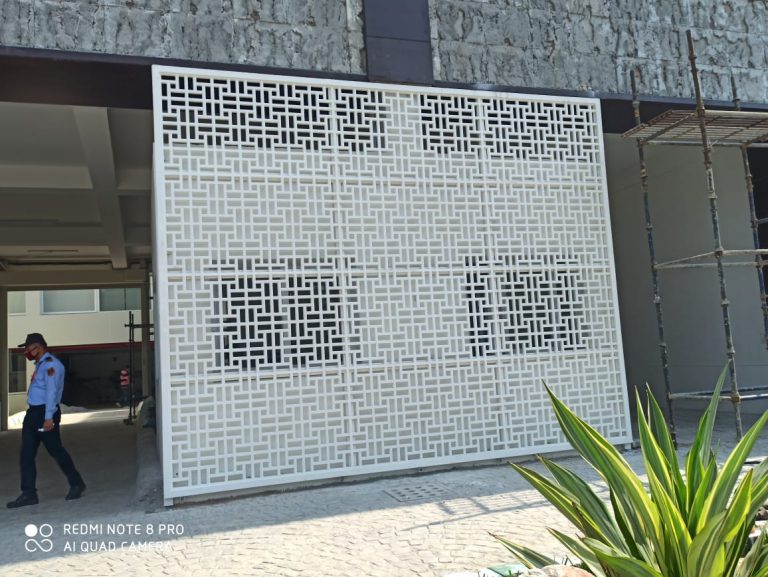
- Jali and screens on elevations and shafts
- Façade cladding panels, window surrounds and fins
- Cornices, columns, capitals and domes
More in What is GRC?
FRP: Fibre Reinforced Plastic (or Polymer)
FRP combines a polymer resin with strong fibres. In civil engineering the term covers two quite different uses:
- Architectural FRP (usually glass fibre, also called GRP): moulded decorative items such as FRP jali, ceiling features, planters, domes, sculptures and props. These are very light, easy to colour, and best suited to interiors or sheltered places.
- Structural FRP (often carbon or glass): rebars, sheets and wraps used to strengthen beams, columns and slabs, and FRP bars used where steel would corrode.
Related terms you’ll see
| Acronym | Full form | What it is |
|---|---|---|
| GFRC | Glass Fibre Reinforced Concrete | Same material as GRC; the name more common in the USA |
| GRP | Glass Reinforced Plastic | FRP made with glass fibre |
| CFRP | Carbon Fibre Reinforced Polymer | High-strength FRP used for structural strengthening |
| AR glass | Alkali-Resistant glass fibre | Zirconia-containing fibre that survives inside cement; essential for GRC |
| RCC | Reinforced Cement Concrete | Concrete with steel bars; the structural frame of most buildings |
| PCC | Plain Cement Concrete | Concrete without reinforcement, used for bedding and levelling |
| SFRC | Steel Fibre Reinforced Concrete | Concrete with short steel fibres, used for industrial floors and tunnels |
| UHPC | Ultra-High Performance Concrete | Very dense, very strong fibre concrete for slim façades and bridges |
GRC vs FRP: the practical differences
| GRC | FRP | |
|---|---|---|
| Binder | Cement | Plastic resin |
| Typical thickness | 10–40 mm | 2–6 mm skin |
| Weight | Light for a concrete product | Very light |
| Fire | Non-combustible | Combustible unless fire-retardant |
| Outdoor ageing | Very good; weathers like stone | Can fade or chalk in strong sun; needs recoating |
| Look and feel | Stone or concrete | Smooth; can be glossy or metallic |
The full comparison, with cost and use cases, is in GRC vs FRP: which should you choose?
RCC, terracotta and cement jali: where they fit
Before GRC, most Indian jali was made in one of three ways, and all three are still used:
- RCC jali: cast-in-place or precast with steel bars. Strong but thick and heavy, because the steel needs concrete cover.
- Cement jali blocks: small precast units laid like masonry, cast in steel or rubber “cement jali moulds”. They’re cheap and durable with limited patterns.
- Terracotta jali: fired clay blocks with an earthy, breathable look, popular in climate-responsive design.
We compare all of them, plus stone, wood, metal and glass, in Types of jali: 9 materials compared.
Frequently asked questions
What is the full form of GRC in civil engineering?
Glass fibre Reinforced Concrete. It is also written as Glass Reinforced Concrete, Glassfibre Reinforced Cement, or GFRC.
What is the full form of FRP?
Fibre Reinforced Plastic, also called Fibre Reinforced Polymer. When the fibre is glass it is also called GRP (Glass Reinforced Plastic) or fibreglass.
Is GRC the same as FRP?
No. GRC uses cement and is non-combustible; FRP uses plastic resin and is much lighter but combustible unless fire-rated.
What is the full form of GFRC?
Glass Fibre Reinforced Concrete, which is the same material as GRC. See GFRC vs GRC.

About the author
Written by the people who draw, mould, cast and install GRC at Asian GRC, a Gurugram manufacturer working in glass fibre reinforced concrete since 2012. Our work includes GRC jali for Taj Palace, New Delhi (G20 Summit 2023) and for power projects of NTPC and NPCIL. Figures in our articles come from our own production and site work, or from the standards and sources we cite.


GRC or FRP for your project?
We make both. Tell us where the piece goes and we'll recommend the right material.