
Types of jali: 9 materials compared
Every jali material involves trade-offs in weight, cost, upkeep and how it ages. Here’s an honest comparison so you can pick the right one for each place in your building.
The main types of jali by material are stone, wood, metal (MS, aluminium, brass), terracotta, cement or RCC, FRP, GRC and glass. For exterior façades and boundary walls, GRC is usually the best balance of look, weight, durability and cost. Stone suits heritage work, wood and brass suit interiors, metal suits slim modern screens, and FRP suits very light, sheltered or indoor uses.
Comparison at a glance
| Material | Weight | Outdoor life | Fire | Relative cost | Best for |
|---|---|---|---|---|---|
| Stone | Very heavy | Excellent | Non-combustible | High (carving) | Heritage, temples, low walls |
| Wood | Light | Poor outdoors | Combustible | Medium–high | Interiors, doors, furniture |
| Metal (MS / aluminium) | Light–medium | Good with coating | Non-combustible | Medium | Modern façades, gates |
| Brass / bronze | Medium | Good, patinates | Non-combustible | High | Luxury interiors, feature panels |
| Terracotta | Medium | Good | Non-combustible | Low–medium | Breathing walls, rustic style |
| Cement / RCC block | Heavy | Good | Non-combustible | Low | Utility screens, budget boundary walls |
| FRP | Very light | Fair; needs repainting | Combustible unless fire-rated | Medium | Ceilings, interiors, retrofits |
| GRC / GFRC | Light for its strength | Excellent | Non-combustible | Medium | Elevations, shafts, boundary walls |
| Glass (etched / back-painted) | Medium | Good | Non-combustible | Medium–high | Interior partitions where you want light, not airflow |
“Relative cost” is a broad guide for a similar pattern and size; actual prices vary with design and quantity.
Stone jali

Carved marble or sandstone is the original jali and still the most prestigious. It lasts centuries and ages beautifully. The downsides are weight (often too heavy for upper floors or slab edges without strengthening), slow hand carving and high cost. Pattern repetition is also limited by the carver’s time. Choose stone for heritage restoration, temples and ground-level features where authenticity matters most.
Wooden jali

Wood is warm and easy to carve or CNC-cut, which makes it ideal for interior partitions, wardrobe shutters and doors. Outdoors it needs regular polishing or painting and is vulnerable to sun, moisture and termites. MDF “jali” panels are cheaper but should only be used indoors and away from damp.
Metal jali (MS, aluminium, brass)

Laser-cut steel and aluminium sheets make crisp, slim, modern screens and gates. Aluminium doesn’t rust; mild steel must be galvanised and powder-coated, and coatings need attention near the coast. Thin sheet looks flat compared with a deep cast jali, because it has no depth to cast shade. Brass and bronze are used as luxury interior features and develop a patina over time.
Terracotta jali

Fired-clay jali blocks and screens are affordable, natural and breathable, and they suit climate-responsive and vernacular-style architecture. Blocks are stacked like masonry, so patterns are limited to what the block shapes allow. Large walls need proper reinforcement and mortar joints, and individual units can chip.
Cement and RCC jali
Precast cement jali blocks and cast-in-place RCC screens are the budget option for boundary walls, utility areas and service shafts. They’re strong and cheap but heavy, with limited detail. RCC jali needs enough cover over its steel to prevent rust, so it can’t be made thin.
FRP jali
Fibre reinforced plastic is the lightest option and can be finished in glossy or metallic colours. It’s ideal for false ceilings, interior features and retrofits where weight is critical. Outdoors in full sun, FRP needs repainting more often than GRC and is combustible unless specially formulated. See our FRP jali page and the full GRC vs FRP comparison.
GRC jali

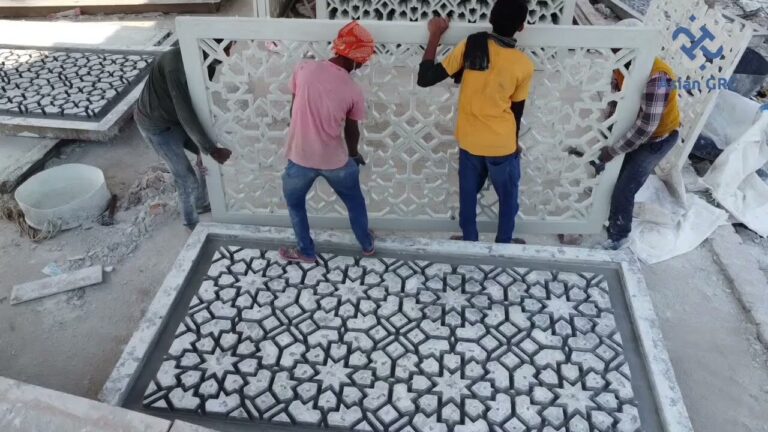
Glass fibre reinforced concrete is a thin cement composite reinforced with alkali-resistant glass fibre instead of steel. It has the solid, mineral look of stone with the detail and repeatability of a moulded product, at 30–35 mm thick for most exteriors. It doesn’t rust, rot or burn, and it handles Indian sun and monsoon well. That’s why it has become the default choice for elevation jali, shaft screens and boundary walls. The trade-offs: it’s heavier than FRP, it needs proper mechanical fixing, and quality depends heavily on the manufacturer. See our GRC jali designs and the complete GRC jali guide.
Glass jali

Etched, frosted or back-painted glass with a jali pattern gives the look of lattice with full daylight and easy cleaning. It doesn’t let air through, so it’s a decorative partition rather than a ventilating screen. It is best for offices, bathrooms and interior dividers.
How to choose
- Exterior, multi-storey, sun and rain: GRC, or coated aluminium for a slim modern look.
- Boundary wall: GRC for detail and durability; cement block or terracotta on a tight budget.
- Interior partition: wood, MDF, brass, glass, or 25 mm GRC for a stone look.
- Ceiling or weight-critical retrofit: FRP.
- Heritage restoration: stone, matching the original.
Frequently asked questions
Which jali material is best for the front elevation?
For most homes and buildings, GRC. It’s durable outdoors, non-combustible and light enough for slab edges, and it allows detailed patterns at a reasonable cost. Aluminium is a good alternative for a slim, contemporary look.
Is GRC jali better than cement jali?
GRC jali is thinner, lighter and more detailed than precast cement blocks, and it has no steel to rust. Cement jali blocks are cheaper and fine for utility walls.
Is FRP jali good for outdoor use?
It can be used outdoors but needs repainting more often in full sun and is combustible unless fire-rated. For exposed exteriors, GRC usually lasts longer with less upkeep.
Which jali is cheapest?
Precast cement and terracotta blocks are usually the cheapest per sq ft. GRC costs more but gives much more design freedom and a thinner, lighter screen.
Can GRC jali be painted?
Yes. Breathable exterior emulsions and textured coatings work well, or it can be left in natural grey or white cement with a clear sealer.

About the author
Written by the people who draw, mould, cast and install GRC at Asian GRC, a Gurugram manufacturer working in glass fibre reinforced concrete since 2012. Our work includes GRC jali for Taj Palace, New Delhi (G20 Summit 2023) and for power projects of NTPC and NPCIL. Figures in our articles come from our own production and site work, or from the standards and sources we cite.


Not sure which jali suits your project?
Tell us where it goes. We make both GRC and FRP jali and will recommend honestly.