
GRC jali: the complete guide to design, thickness, cost and installation
What we explain to homeowners, architects and contractors before they order a GRC jali, in one place and in the order decisions actually get made.
- What it is: a perforated screen cast in glass fibre reinforced concrete (GRC), used on elevations, staircase shafts, boundary walls and interiors.
- Thickness: 25 mm for interiors, 30–35 mm for most exteriors, and 40 mm or a steel frame for large or high panels.
- Cost: standard designs start at about ₹350 per sq ft for supply. Custom moulds, thickness, finish, height and quantity change the rate.
- Fixing: stainless-steel anchors into RCC, an MS or stainless sub-frame, or cast-in inserts. Never just mortar.
- Upkeep: occasional washing, with a sealer or exterior paint renewed every few years outdoors.

What is a GRC jali?
A jali (or jaali) is a perforated screen, traditionally carved in stone or wood, that lets light and air through while breaking up the view. A GRC jali brings that idea to modern buildings in glass fibre reinforced concrete: a thin, fibre-reinforced cement casting that looks like carved stone but weighs a fraction as much and doesn’t rust or rot.
Because every piece comes out of a mould, the same pattern can be repeated across a whole façade with consistent detail. That is something hand carving can’t do economically.
Where GRC jali works best
| Location | Why jali | Points to plan |
|---|---|---|
| Front elevation | Identity, shading, privacy for balconies | Pattern scale should read from the street; plan fixing to slab edges |
| Staircase / lift shaft | Ventilation and daylight without open walls | Large heights need modules and a sub-frame |
| Boundary wall | Airflow and partial view instead of a blank wall | Panels between RCC posts; protect the lower edge from water and soil |
| Terrace and parapet | Privacy screen while keeping breeze | Wind load; fix securely top and bottom |
| Interior partition | Separate spaces without blocking light | Thinner (25 mm) and lighter; painted finishes common |
| Industrial and institutional | Screening plant, shafts and services | Repeatable modules; durability over decoration |
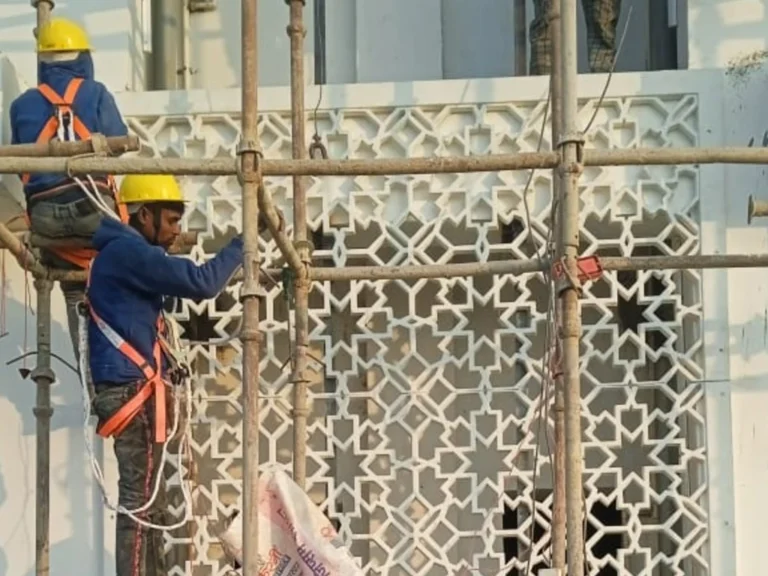
Examples from our own work include façade screens at Taj Palace, New Delhi, shaft jali for NTPC Tandwa and campus jali for Patanjali Yogpeeth, Haridwar.
Choosing a pattern
Four practical questions narrow the choice quickly:
- How much open area do you want? Around 30–40% open feels private; 50–60% feels airy and light. More opening means less shade and less privacy.
- From how far will it be seen? Fine detail disappears at a distance. Façade jali seen from the road needs bolder pattern elements than an interior screen seen up close.
- Traditional or modern? Mughal geometry and floral motifs suit heritage, temple and hospitality projects. Linear, hexagonal and parametric patterns suit contemporary buildings.
- Catalogue or custom? A catalogue design uses a mould that already exists, so it is quicker and cheaper. A custom design needs a new pattern and mould, which pays off on larger areas.
Browse our GRC jali designs, or send your own drawing.
How thick should it be?
Thickness is a structural decision, not a style choice. It depends on panel size, height above ground, wind exposure and how much of the panel is open.
| Thickness | Typical use |
|---|---|
| 25 mm | Interior partitions, small decorative panels, low boundary infill |
| 30 mm | Boundary walls, terrace screens, ground and first-floor elevations |
| 35 mm | Multi-storey elevations and shafts; our most common façade specification |
| 40 mm or with a steel frame | Large panels, high-rise or high-wind locations, patterns with large openings |
A useful rule of thumb for load: GRC weighs about 2,000 kg/m³, so a solid 35 mm panel is roughly 70 kg per m². With 40% of the area open, that drops to around 40 kg per m², which is light enough for most slab edges and parapets without strengthening.
What does GRC jali cost?
Standard GRC jali starts at about ₹350 per sq ft for supply. The final rate depends on:
- Design: catalogue patterns are cheaper than custom moulds; deep 3D relief costs more than flat patterns.
- Thickness: more material and more fibre per sq ft.
- Finish: grey cement, white cement, sandstone tones or paint.
- Quantity: mould cost is spread over the area, so larger orders get better rates. Our minimum order is 1,000 sq ft in Delhi NCR and 1,500 sq ft elsewhere.
- Installation and access: height, scaffolding, sub-frames and distance from our works.
When comparing quotes, compare like with like: the same thickness, fibre (AR glass), finish and scope (supply only, or supply and fix).
How GRC jali is installed
- Site check: measure openings, check RCC members, and confirm levels before casting starts.
- Fixing design: decide the method for each location. Common options are stainless-steel anchors into beams and columns, an MS (galvanised or painted) or stainless sub-frame for large areas, or cast-in sockets bolted to brackets.
- Setting out: mark panel joints so the pattern runs continuously across modules.
- Fixing: lift panels into place, bolt them, and keep a small joint (typically 5–10 mm) between modules for movement.
- Jointing and finishing: fill joints with a flexible sealant or matching filler, touch up, and apply the final coating.
The most common mistake we see is fixing jali with mortar alone. It may look fine on day one, but mortar has no tensile capacity, and wind or thermal movement eventually loosens the panel. Ask your installer how each panel is mechanically held.
Finishes and colours
- Natural grey or white cement: honest, stone-like and low maintenance. White cement shows dirt sooner.
- Sandstone tones: pigmented mixes that echo Dholpur or Jaisalmer stone.
- Painted: any shade using breathable exterior emulsion or textured coatings. Good for matching the building.
- Sealed: a clear breathable sealer reduces water absorption and staining without changing the look much.
Maintenance
GRC jali needs little care, but not none:
- Wash with water and a soft brush or low-pressure spray once or twice a year, more often near roads.
- Recoat paint or sealer every 4–6 years on exteriors, depending on exposure.
- Check fixings and joint sealant after the first monsoon and then every few years.
- Repair chips with a polymer-modified GRC repair mortar; don’t leave exposed fibres open to water.
More answers are on our GRC jali FAQ page.
Before you order: a short checklist
- Elevation drawing with jali areas marked and sizes of each opening.
- Pattern chosen, or your own drawing for a custom design.
- Thickness and fixing method agreed in writing.
- Finish and colour, with a sample approved.
- Scope clear: supply only, or supply and installation, and who provides scaffolding.
- Written lead time and payment milestones.
Frequently asked questions
Is GRC jali better than stone jali?
For most modern buildings, yes. It gives a similar look at a fraction of the weight, repeats patterns consistently, and costs much less than hand-carved stone. Stone remains the choice for heritage restoration where authenticity matters.
Can GRC jali be used outdoors?
Yes. Made with AR glass fibre and properly cured, it handles sun, rain and temperature swings well. Use 30 mm or more for exteriors and protect the surface with sealer or exterior paint.
What is the price of GRC jali per sq ft?
About ₹350 per sq ft for standard designs, supply only. Custom moulds, thicker sections, special finishes and installation add to this.
How long does a GRC jali order take?
Catalogue designs are quicker because moulds already exist. Custom designs need extra time for the pattern, mould and sample approval. We give a written lead time with every quote.
Does GRC jali crack?
Good GRC jali doesn’t crack under normal conditions. Cracking usually traces back to non-AR fibre, poor curing, too thin a section for the panel size, or rigid fixing that stops the panel from moving.

About the author
Written by the people who draw, mould, cast and install GRC at Asian GRC, a Gurugram manufacturer working in glass fibre reinforced concrete since 2012. Our work includes GRC jali for Taj Palace, New Delhi (G20 Summit 2023) and for power projects of NTPC and NPCIL. Figures in our articles come from our own production and site work, or from the standards and sources we cite.
Related articles


Planning a GRC jali?
Send your elevation or a photo of the wall. We'll suggest pattern, thickness and fixing, and send a written quote.