
How to choose a GRC jali pattern
Most people choose a jali from a catalogue photo. A better way is to decide what the screen has to do first, then pick the pattern that does it. This guide walks through that decision.
Choose a GRC jali pattern in four steps: decide its main job (privacy, light, airflow or shade), set the open area that job needs, size the motif for the distance it will be seen from, and match the style to the building. Small, dense patterns with less open area give privacy. Larger openings give light and air. Motifs that look right from 2 m usually look busy and grey from across the road, so façade jali generally needs a bolder, larger repeat than an interior screen.

Step 1: Decide the screen’s main job
A jali almost always does several things at once, but one of them should lead the design. Ask which of these matters most for this opening:
| Main job | What the pattern needs | Typical locations |
|---|---|---|
| Privacy | Smaller openings, deeper sections, little direct line of sight | Balconies facing neighbours, bathrooms, ground-floor windows on a street |
| Daylight | More open area, openings spread evenly over the panel | Staircases, lobbies, corridors |
| Airflow | Large, connected openings with little obstruction | Service shafts, AC ledges, car parks, utility areas |
| Sun shading | Deep sections (thicker panel), pattern set out to block low sun | West and south elevations, glazed façades |
| Identity | A distinctive motif read from a distance | Main elevation, gate, entrance canopy |
Step 2: Set the open area
Open area is the share of the panel that is hole rather than solid. It is the single number that most changes how a jali performs. Ask your supplier to state it for any pattern you shortlist, because two patterns that look similar in a photo can differ a lot.
- Lower open area means more privacy, more shade and a heavier panel. Rooms behind it will be darker.
- Higher open area means more light, more air and a lighter panel. You will see more of the inside from the street, especially at night when the interior is lit.
- Night-time privacy is worse than daytime. A lit room behind a jali is visible through openings that seemed opaque during the day. If night privacy matters, choose a denser pattern or plan curtains or blinds behind it.
There is also a structural limit. The solid ribs between openings carry the panel’s weight and wind load. Very open patterns with thin ribs need a thicker panel, smaller modules or a frame behind them. Most GRC jali is 25–40 mm thick, with 30–35 mm the most common. See our complete GRC jali guide for how thickness is chosen.
Step 3: Match motif size to viewing distance
This is the step most often missed. A fine floral pattern that looks beautiful on a sample held at arm’s length can turn into a grey haze on the fourth floor seen from the road. As a working rule:
- Seen up close (interiors, boundary walls at eye level, entrances): fine detail, smaller repeats and layered patterns all read well.
- Seen from across a street or garden: choose a bolder repeat with clear solid ribs so the pattern still reads.
- Seen from far away (high-rise façades, institutional buildings): simple geometry with large openings and strong shadow lines. The panel’s depth and shadow do more work than surface detail.
When you can, view a full-size sample panel in place, or at least at the distance people will actually see it from.
Step 4: Match the style to the building
| Building style | Patterns that usually suit it |
|---|---|
| Contemporary | Geometric grids, offset rectangles, parametric waves, vertical slots |
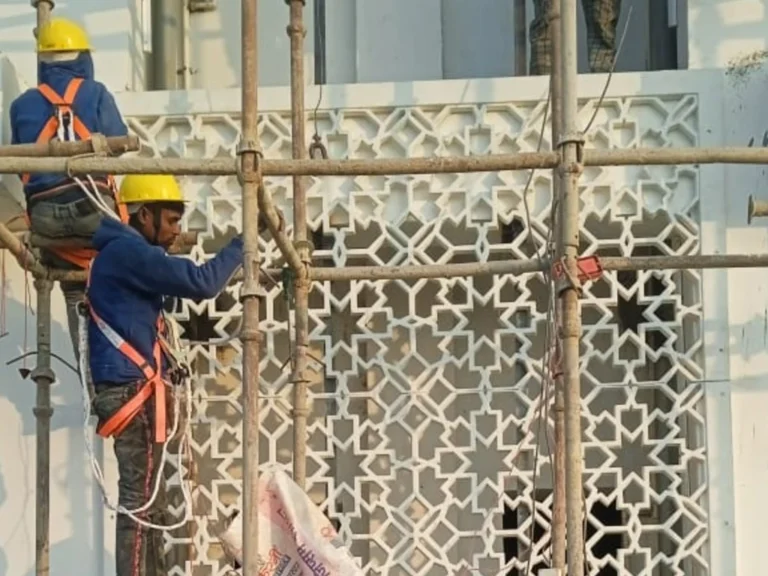
| Indo-Islamic and Mughal | Star and polygon lattices, arch-headed panels, interlaced geometry |
| Rajasthani and haveli | Floral and creeper motifs, jharokha frames, fine lattice |
| Temple and traditional | Lotus, bell and petal motifs, borders and bands |
| Corporate and institutional | Simple repeating modules that tile across large areas and hide joints |
Browse our GRC jali designs and the design catalogue for starting points. A good supplier can scale, simplify or combine patterns to fit your openings.
Orientation changes the right choice
The same pattern performs differently on each face of a building in India:
- West: harsh, low afternoon sun. Favour deeper sections and lower open area. This is where a jali pays for itself in comfort.
- South: high sun for much of the year. Horizontal elements and moderate open area work well.
- East: morning sun that is softer. You can usually open the pattern up.
- North: steady indirect light. Choose for privacy and looks; heat is rarely the issue.
Plan the modules and joints
A jali is made in panels and joined on site, so the pattern must repeat cleanly at panel edges. Before fixing a pattern:
- Check that the opening width divides into whole pattern repeats, or plan a border that takes up the difference.
- Keep joints on a solid rib, not through the middle of a motif.
- Keep each module to a size that can be lifted and fixed safely at that height.
- Agree where fixing brackets go so they sit behind solid parts of the pattern.
How pattern affects cost
Pattern changes price in three ways: the mould, the material and the labour.
- Catalogue pattern vs new design: an existing mould avoids pattern-making cost. A custom design needs a new master and mould.
- Number of different panels: one module repeated many times is much cheaper per sq ft than many unique panels.
- Depth and detail: deep relief and undercuts take longer to demould and finish.
GRC jali starts from about ₹350 per sq ft for standard designs. For what moves the price above that, see our GRC jali FAQ.
Checklist before you order
- Main job of the screen written down (privacy, light, air, shade or identity).
- Open area of the shortlisted pattern stated by the supplier.
- Pattern checked at real viewing distance, ideally on a full-size sample.
- Night-time view considered for rooms that will be lit.
- Module sizes and joint positions marked on the elevation.
- Thickness confirmed for the panel size and wind exposure.
- Finish and colour approved on a sample in daylight.
Frequently asked questions
Which jali pattern gives the most privacy?
Dense patterns with small openings, and thicker panels whose depth blocks sideways views. Remember that privacy drops at night when the room behind is lit.
Which jali design is best for ventilation?
Patterns with large, connected openings and slim solid ribs. For service shafts and AC areas, airflow should lead the choice, not looks.
Can I get my own jali design made in GRC?
Yes. A custom design needs a master pattern and mould, which adds time and cost, so it suits larger areas or a signature element.
Should the jali pattern be the same on every floor?
Not necessarily. Many buildings use a denser pattern lower down for privacy and a more open one above for light, keeping the same motif family so the façade reads as one design.

About the author
Written by the people who draw, mould, cast and install GRC at Asian GRC, a Gurugram manufacturer working in glass fibre reinforced concrete since 2012. Our work includes GRC jali for Taj Palace, New Delhi (G20 Summit 2023) and for power projects of NTPC and NPCIL. Figures in our articles come from our own production and site work, or from the standards and sources we cite.
Related articles


Shortlisted a few patterns?
Send the elevation and the patterns you like. We'll tell you the open area, thickness and module layout for each.