
GFRC vs GRC: is there any difference?
Short answer: no. They are two names for one material. The differences that matter are in how a supplier makes it, and those don’t depend on which name is on the quotation.
GFRC (glass fibre reinforced concrete) and GRC (glass reinforced concrete, or glassfibre reinforced cement) are the same material. Both are a thin cement-and-sand mortar reinforced with alkali-resistant (AR) glass fibre. “GRC” is the usual term in the UK, Middle East and India; “GFRC” is more common in the USA. The real differences between products come from the manufacturing method (spray or premix), the fibre content, the type of fibre and the curing, not from the name.

Why the material has two names
Glass fibre reinforced concrete was developed in Britain. The UK’s Building Research Establishment developed an alkali-resistant glass fibre in the late 1960s, and Pilkington launched it commercially in the early 1970s. The British industry called the material GRC, and its trade body is still the Glassfibre Reinforced Concrete Association (GRCA).
When the technology reached North America, the industry there generally used GFRC, and the US precast body (PCI) uses “glass fiber reinforced concrete” in its specification. Neither name is more correct. Which one you hear mostly depends on where your architect, consultant or supplier learned the trade.
In India you will see GRC, GFRC and even “GRC/GFRC” on the same drawing. A GRC jali and a GFRC jali, for example, are the same kind of product.
What the material actually is
Whatever you call it, the recipe has four parts:
- Cement: usually OPC 53 grade, white cement for light finishes.
- Fine sand: washed silica sand, much finer than concrete sand. There is no coarse aggregate (gravel).
- AR glass fibre: fibre containing zirconia, so the cement’s alkalinity doesn’t eat it. This replaces steel bars.
- Admixtures: a superplasticiser for workability and often an acrylic polymer, which helps curing and reduces surface cracking.
Because there is no steel to rust, there is no need for thick concrete cover. That is why GRC/GFRC can be cast 10–40 mm thick and is so much lighter than precast concrete of the same shape. Our plain-English guide to GRC covers the basics in more detail.
What really differs between two “GRC” products
If the name doesn’t tell you anything, these points do. Ask about them when you compare quotes:
| Factor | What to ask | Why it matters |
|---|---|---|
| Fibre type | Is it AR (alkali-resistant) glass fibre? | Ordinary E-glass is attacked by cement over time and the panel loses strength. |
| Method | Sprayed or premixed? | Sprayed GRC carries more fibre and is stronger in bending; premix suits small, detailed castings. |
| Fibre content | What percentage by weight? | Typically about 5% for spray and 2–3.5% for premix. Less fibre means less strength. |
| Thickness | What thickness is quoted? | A 20 mm panel and a 35 mm panel are not the same product, even at the same rate. |
| Curing | How long, and how? | Poorly cured panels can craze, curl or lose strength. About 7 days moist curing, or a polymer system. |
| Testing | Do you test bending strength? | Regular test boards show whether the mix is consistent from batch to batch. |
Spray GRC vs premix GRC
This is the one technical distinction that does change what you get. Both are “GRC” and both are “GFRC”.
- Spray (spray-up) GRC: cement slurry and chopped AR fibre are sprayed together into the mould in thin layers and compacted by hand roller. The result has higher fibre content and higher flexural strength. It is used for façade panels, large jali and cladding.
- Premix GRC: short fibres are mixed into the mortar, which is then poured or vibrated into the mould. It is quicker for small, intricate or solid pieces such as capitals, balusters, brackets and sculptures, but it is weaker in bending than spray.
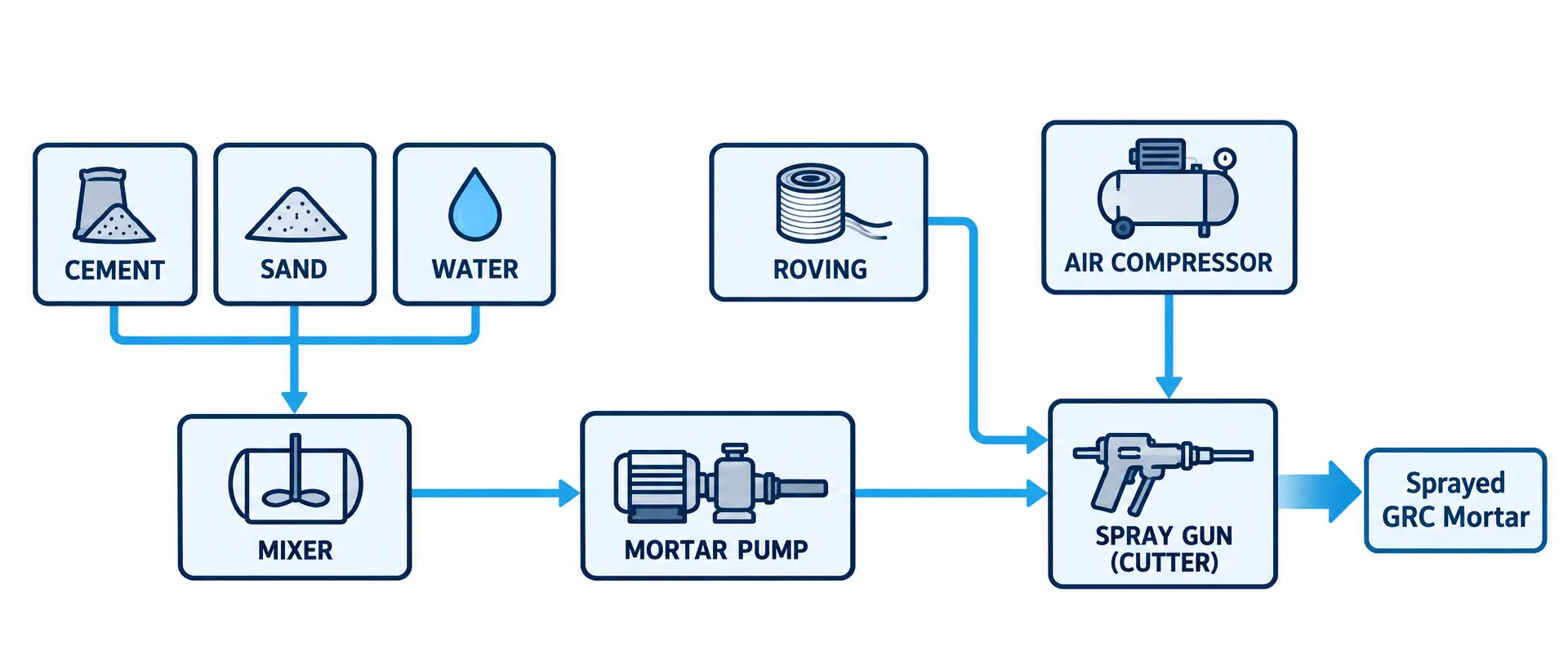
Typical properties for each method are in our GRC technical data sheet.
Don’t confuse GRC with GRP or FRP
This mix-up costs people money. The letters look similar but the materials are completely different:
| Term | Stands for | Binder | Behaviour |
|---|---|---|---|
| GRC / GFRC | Glass fibre reinforced concrete | Cement | Mineral, non-combustible, feels like stone |
| GRP / FRP | Glass reinforced plastic / fibre reinforced plastic | Polyester or epoxy resin | Very light, can be glossy, combustible unless fire-rated |
If a quotation says “GRP jali” when your drawing says “GRC jali”, you are being offered a different product. See our full GRC vs FRP comparison for when each one makes sense.
Which term should you use?
Use whichever your project documents already use, and be consistent. What protects you is the specification, not the label: name AR glass fibre, the method (spray or premix), the minimum thickness and the finish. A good supplier will be happy to put all of that in writing.
Frequently asked questions
Is GFRC stronger than GRC?
No. They are the same material, so neither is stronger by name. Strength depends on the fibre content, the method (spray is stronger in bending than premix), thickness and curing.
What is the full form of GRC?
GRC stands for Glass fibre Reinforced Concrete. It is also written as Glass Reinforced Concrete or Glassfibre Reinforced Cement. GFRC stands for Glass Fibre Reinforced Concrete.
Is GRC the same as GRP?
No. GRC uses cement as the binder and is non-combustible. GRP (glass reinforced plastic, also called FRP) uses plastic resin. They look similar on drawings but behave very differently outdoors and in fire.
Why do Indian suppliers say GRC and American websites say GFRC?
The material and its trade association started in Britain, where it was called GRC. Indian, Middle Eastern and British practice mostly kept that name, while North American industry generally uses GFRC.
Sources and further reading
- Glassfibre Reinforced Concrete Association (GRCA), the UK trade body.
- PCI Journal (1977): Glass Fiber Reinforced Concrete Products, Properties and Applications, on the development of AR glass fibre.
- BS EN 15422: specification of glass fibres for reinforcement of mortars and concretes.

About the author
Written by the people who draw, mould, cast and install GRC at Asian GRC, a Gurugram manufacturer working in glass fibre reinforced concrete since 2012. Our work includes GRC jali for Taj Palace, New Delhi (G20 Summit 2023) and for power projects of NTPC and NPCIL. Figures in our articles come from our own production and site work, or from the standards and sources we cite.
Related articles

Need GRC (or GFRC) for your project?
Send your drawing. We'll quote AR-glass GRC with the thickness, method and finish written on the quotation.