
Material comparison
GRC vs FRP: which should you use?
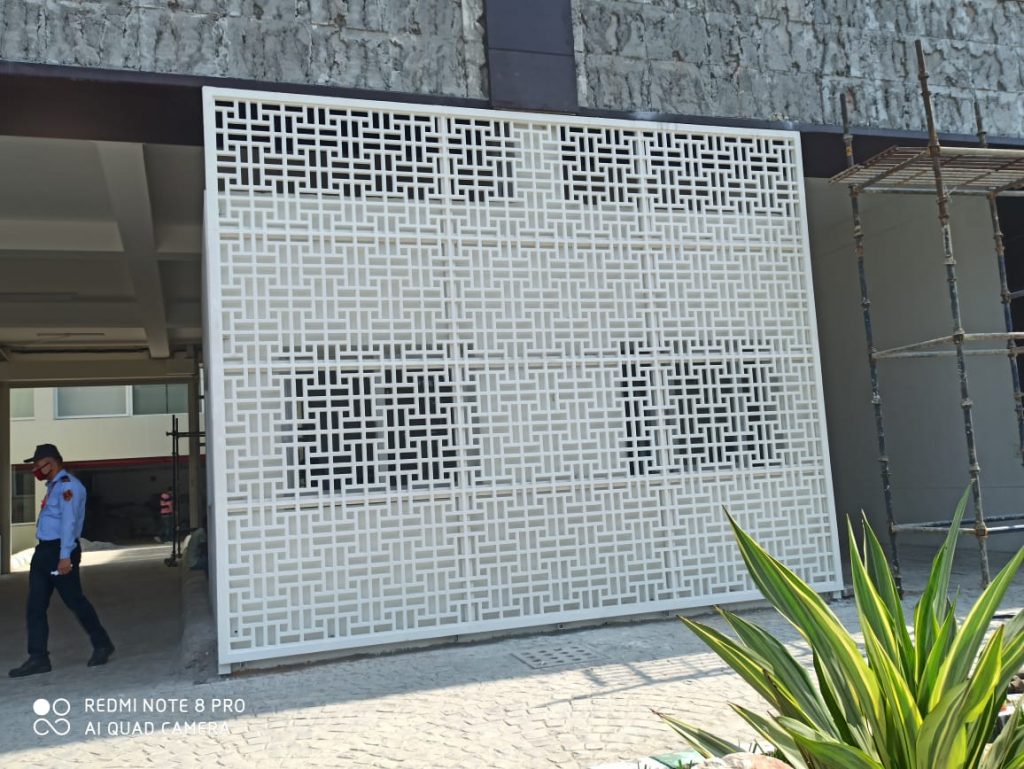
Both GRC and FRP use glass fibre, and both can be moulded into jali, domes, columns and planters. But one is a concrete and the other is a plastic, and that changes how they look, how they age, and where they are safe to use. We make both, so here is a straight comparison.
Short answer
The quick rule
Use GRC (GFRC) when…
- It is outdoors in full sun and rain
- Fire safety matters
- You want a solid stone or concrete look and feel
- You want decades of life with minimal upkeep
Use FRP when…
- Weight must be as low as possible (ceilings, retrofits)
- It is indoors or sheltered
- You need glossy colours or metallic finishes
- Pieces must be moved often (planters, props)
Side by side
GRC vs FRP comparison table
| GRC / GFRC | FRP / fibreglass | |
|---|---|---|
| Matrix | Cement and fine sand (a concrete) | Polyester or epoxy resin (a plastic) |
| Reinforcement | Alkali-resistant glass fibre | Glass fibre mat or roving |
| Typical thickness | 10–40 mm | 2–6 mm skin |
| Density | About 1.8–2.1 t/m³ | About 1.5–1.9 t/m³, but much thinner, so far lighter per piece |
| Fire | Non-combustible | Combustible (fire-retardant resins reduce this) |
| Sun and UV | Unaffected | Can fade or chalk without a good gelcoat or paint |
| Look and feel | Stone-like, solid, cool to touch | Smooth, lighter, can sound hollow |
| Detail | Very fine detail and crisp edges | Fine detail; thin edges can flex |
| Impact | Can chip on a hard knock | Resists chipping; can crack or dent |
| Maintenance | Wash; repaint only for a colour change | Repaint or re-gelcoat more often outdoors |
| Best for | Façades, jali, cladding, balustrades, domes | Ceilings, interiors, planters, signage, retrofits |
Cost: GRC vs FRP
For façade jali, GRC and FRP are often close in price per sq ft. FRP can work out cheaper for small, light decorative pieces; GRC usually works out better over the life of an exterior job because it needs less repainting and doesn’t degrade in sun. For a fair comparison, ask both quotes for the same thickness, finish and fixing.
Common mistakes
- Using FRP for an exterior jali to save weight when the structure could easily take GRC. It will need repainting sooner and is combustible.
- Using GRC for a large ceiling dome where FRP or GRG would be far lighter and simpler to hang.
- Comparing prices without comparing thickness: a 20 mm GRC jali is not the same product as a 35 mm one.
FAQ
GRC vs FRP questions
Which is stronger, GRC or FRP?
FRP has a higher strength-to-weight ratio. GRC is stiffer and more solid, and for façade elements its strength is more than enough at normal thickness.
Which lasts longer outdoors?
GRC. It is unaffected by UV and does not burn. FRP lasts well outdoors only with a good UV-stable gelcoat or paint that is maintained.
Is FRP jali cheaper than GRC jali?
Not always. Prices are often similar for façade jali; the difference depends on design, thickness and finish.
Can GRC and FRP look the same?
Painted, they can look similar from a distance. Up close and to the touch, GRC feels like stone; FRP feels lighter and smoother.
Not sure which material?
Tell us where the piece goes and how big it is. We make both and will recommend the right one.