
Guide for architects & builders
Glass fibre reinforced concrete (GFRC): a practical guide
This guide covers what you need to design and specify GFRC elements: how the material behaves, how it is made, what thickness and fixings to plan for, and what to put in your specification. It is based on how we design and manufacture GFRC every day.

1. What GFRC is
Glass fibre reinforced concrete is a cement-based composite: a fine mortar of cement, silica sand, water and admixtures, reinforced with alkali-resistant (AR) glass fibre. The fibres take tensile and bending stress, so GFRC is designed as a thin-shell material, usually 10–40 mm thick, rather than as a bulk concrete.
It is classified by flexural strength (modulus of rupture, MOR) rather than compressive strength, because bending is what governs thin panels.
2. Key properties
| Property | Unit | Spray GRC | Premix GRC |
|---|---|---|---|
| Flexural strength (MOR) | MPa | 20–30 | 10–14 |
| Limit of proportionality (LOP) | MPa | 7–11 | 5–8 |
| Compressive strength | MPa | 50–80 | 40–60 |
| Interlaminar shear | MPa | 3–5 | — |
| In-plane shear | MPa | 8–11 | 4–7 |
| Impact strength | kJ/m² | 10–25 | 10–15 |
| Elastic modulus | GPa | 10–20 | 10–20 |
| Strain to failure | % | 0.6–1.2 | 0.1–0.2 |
| Dry density | t/m³ | 1.9–2.1 | 1.8–2.0 |
Other practical properties:
- Non-combustible: the material does not burn.
- Corrosion-free: no steel reinforcement to rust; any embedded fixings should be stainless steel.
- Low permeability: a dense, polymer-modified matrix resists water and staining.
- Moisture movement: GFRC expands and shrinks slightly with wetting and drying, so large panels need flexible fixings and movement joints.
3. Spray-up vs premix
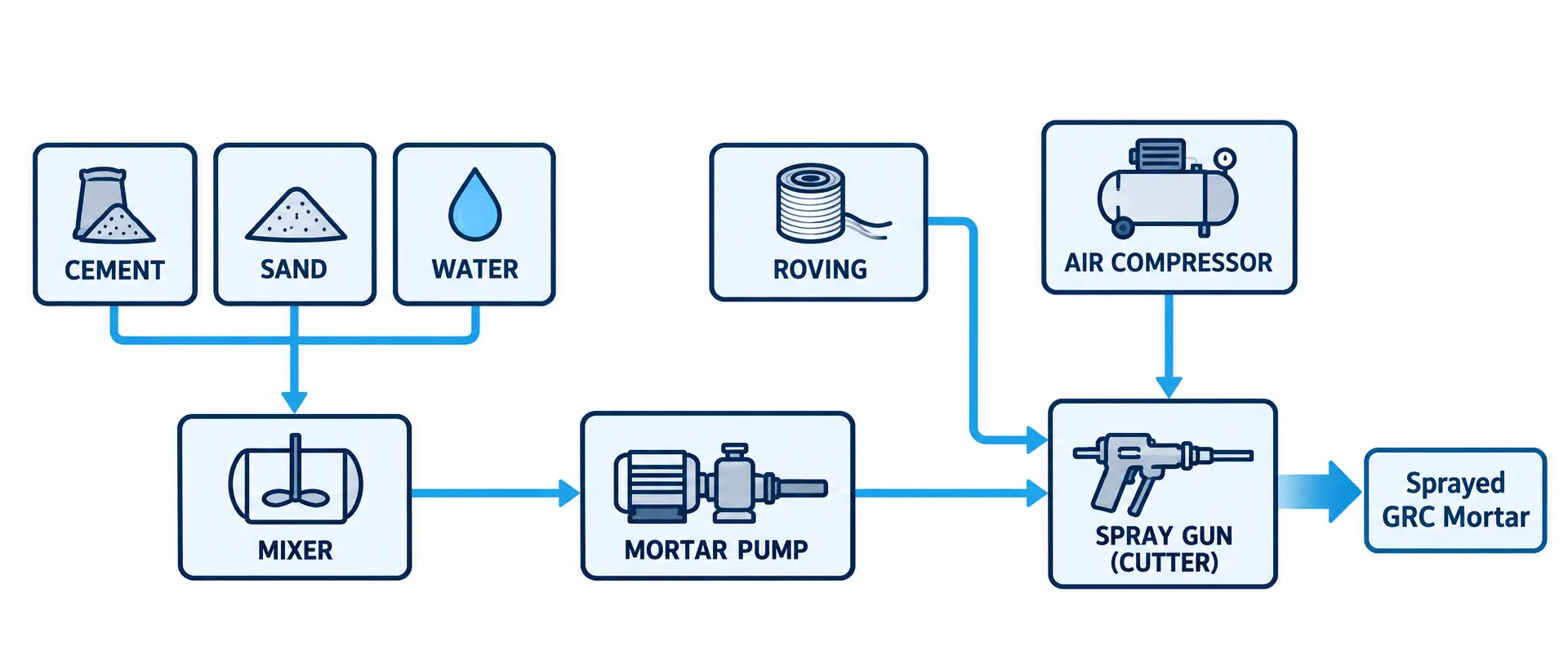
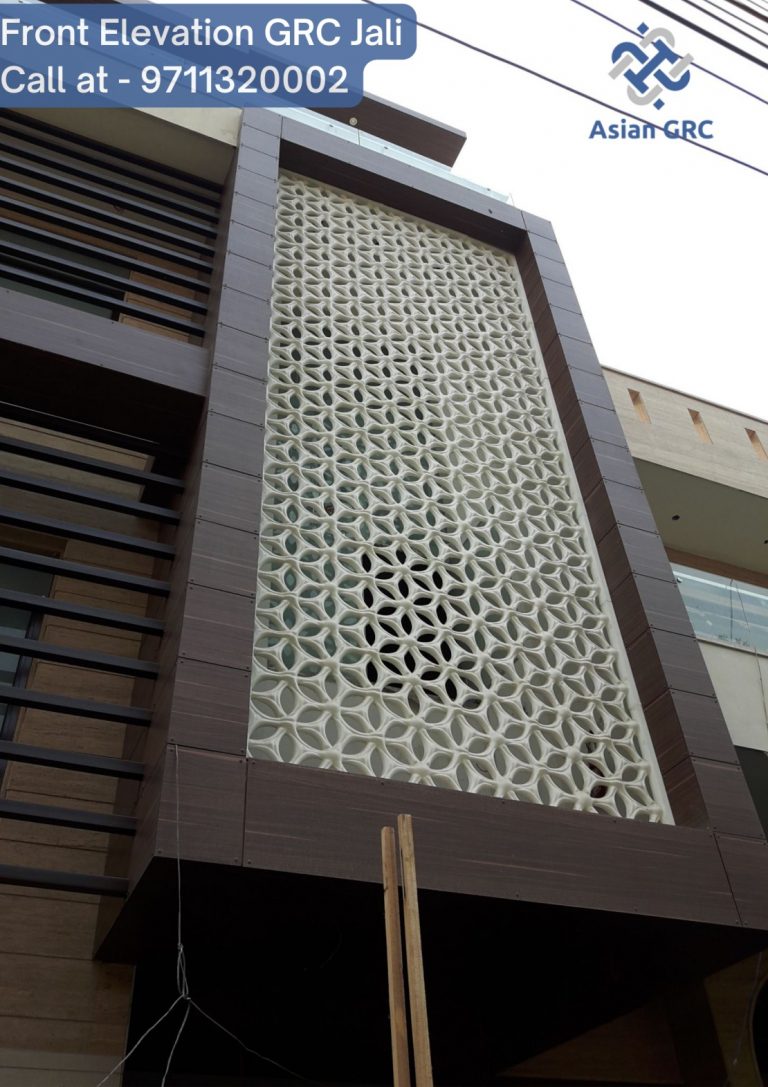
Spray-up sprays slurry and chopped continuous roving (about 32 mm long) together, in thin compacted layers, at around 5% fibre. It gives the highest strength and is used for large façade panels. Premix blends shorter fibres (about 13 mm) into the mix, which is then cast and vibrated, at 2–3.5% fibre. It suits smaller, intricate and repeat items such as jali units, balusters and mouldings. More detail is in our technical data sheet.
4. Designing GFRC elements
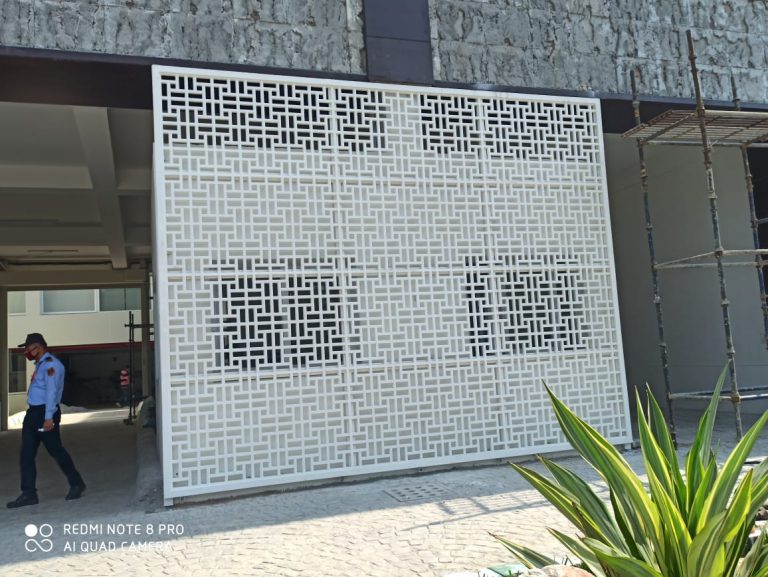
- Thickness: typically 10–15 mm skins for stud-frame panels, 25–40 mm for self-supporting jali and screens.
- Panel size: limited by handling, transport and stiffness. Large panels use a steel stud frame or integral ribs.
- Fixings: use flexible anchors that allow movement; avoid rigidly restraining a panel on all sides.
- Joints: plan sealed joints between panels to take movement and tolerances.
- Drips and edges: include drips on soffits and avoid sharp thin edges that chip.
5. Finishes
GFRC can be supplied in natural grey or white cement, with pigments for integral colour, acid-etched or sand-blasted for a stone texture, or painted with exterior acrylic or texture coatings. A breathable sealer reduces dirt pick-up on light colours.
6. What to put in your specification
- AR glass fibre to recognised standards, with fibre content by weight stated for spray or premix
- Minimum flexural strength (MOR) and LOP values, and how they will be tested
- Curing method and duration before dispatch
- Thickness tolerance, dimensional tolerance and surface finish standard
- Stainless-steel fixings and anchor design responsibility
- Sample panel approval before production
See our GRC specification page for a ready-to-adapt specification outline.
FAQ
GFRC questions
Is GFRC the same as GRC?
Yes. GFRC and GRC are two names for glass fibre reinforced concrete.
Is GFRC fire-resistant?
GFRC is non-combustible. Fire performance of a complete façade system also depends on fixings, insulation and cavities, so check the whole system.
How much lighter is GFRC than precast concrete?
Because panels are thin, GFRC elements are typically up to 75% lighter than the same element in conventional precast concrete.
Can GFRC be repaired?
Yes. Chips and minor damage are repaired with matching polymer-modified mortars; badly damaged units can be replaced from the original mould.
Is GFRC more expensive than concrete?
Per kilogram, yes. Per element installed, it is often competitive because it is lighter to transport, needs less supporting structure and installs faster.


Specifying GFRC?
Send your drawings and we'll advise on thickness, panelisation and fixing, and give a budget price.