
Inside the material
Glass reinforced concrete jali: how it is made and why it lasts
Two jali panels can look the same on delivery day and age very differently. The difference is in the mix, the fibre and the curing. This page explains what goes into a glass reinforced concrete jali and what to ask your supplier.
- 2012Manufacturing since
- 14+ yrsGRC experience
- 73Google reviews
- Pan-IndiaSupply & installation
Trusted on projects for
 Taj Palace, New Delhi
 NTPC
 NPCIL
 Delhi Jal Board
 DLF
 Jaypee Greens, Noida
The mix
What goes into glass reinforced concrete
GRC is a fine-grained mortar, not ordinary concrete. There is no coarse aggregate, which is why it can reproduce fine jali detail.
| Component | Spray GRC | Premix GRC |
|---|---|---|
| Cement (OPC 53) | 50 kg | 50 kg |
| Fine silica sand | 50 kg | 50 kg |
| AR glass fibre | 4.5–5% by weight | 2–3.5% by weight |
| Superplasticiser | 0.5 kg | 0.5 kg |
| Acrylic polymer | 5 kg | 5 kg |
| Water | 13.5 litres | 14.5 litres |
Cement and sand
OPC with fine silica sand gives a dense, smooth matrix and sharp edges.
AR glass fibre
Alkali-resistant glass contains zirconia, which protects the fibre from the alkaline cement so strength is kept over time. Ordinary E-glass loses strength in cement.
Polymer
An acrylic polymer improves curing, reduces fine cracking and lowers water absorption.
Step by step
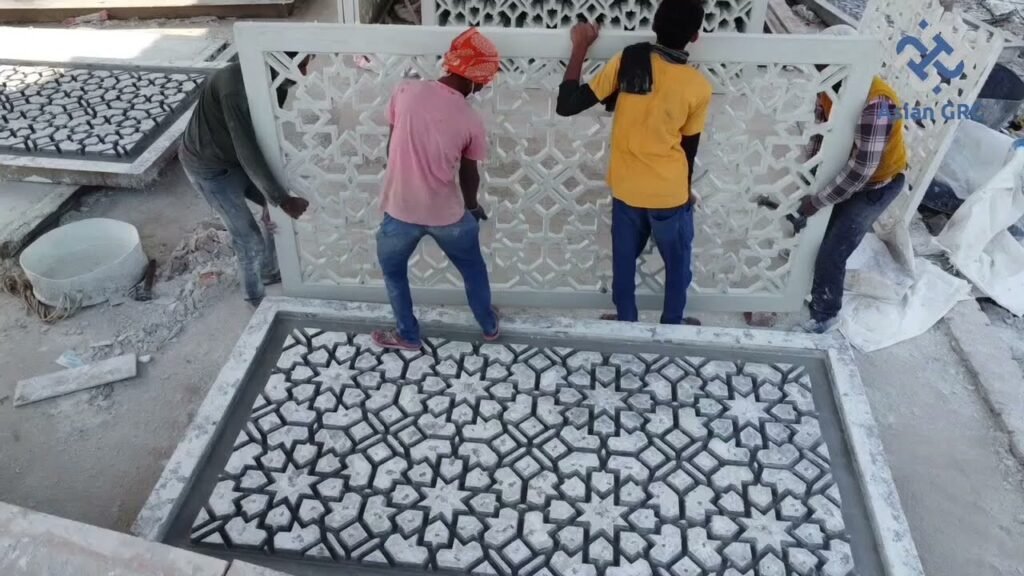
How a GRC jali panel is made
- Master and mouldThe pattern is drawn in CAD, a master is made, and a rubber or FRP mould is taken from it.
- MixingSlurry is mixed in a high-shear mixer for 1–2 minutes until smooth; consistency is checked with a slump test.
- CastingSpray-up: slurry and chopped fibre are sprayed in layers and rolled. Premix: fibre-loaded mix is poured and vibrated.
- DemouldingThe panel stays covered in the mould overnight so it does not lose moisture, then it is demoulded.
- CuringPanels are kept moist under polythene for about 7 days, or a polymer curing system is used.
- Finishing and QCEdges are dressed, panels are checked for size and defects, then sealed or painted if specified.
Buyer’s checklist
Questions to ask any GRC jali supplier
- Is the fibre alkali-resistant (AR) glass? Ask for the fibre datasheet.
- What fibre percentage is used, and is it spray or premix?
- How are panels cured, and for how long before dispatch?
- What thickness is proposed for my panel size and height?
- How will panels be fixed, and who installs them?
- Can I see a sample and a finished project nearby?
We answer all of these in writing with our quote. Our AR fibre datasheet is here (PDF).

FAQ
Glass reinforced concrete jali questions
Is glass reinforced concrete the same as GRC and GFRC?
Yes. Glass reinforced concrete (GRC), glass fibre reinforced concrete (GFRC) and glassfibre reinforced cement all refer to the same material.
Does the glass in GRC make it fragile?
No. The glass is in the form of fine fibres spread through the mix. They make the concrete tougher and stop cracks from opening, which is why GRC can be so thin.
Why can GRC be thinner than normal concrete?
Normal reinforced concrete needs cover over its steel bars to stop rust. GRC has no steel to protect, so thickness is set only by the strength needed.
Is GRC eco-friendly?
It uses far less material than a solid concrete or stone element of the same size, which means less cement, lighter transport and smaller supporting structures.
Get a quote for your project
Send your drawing or design photo. We reply with a price, lead time and fixing plan.